Do You Know What Specialty Coffee Is? Consciência Café Tells You!
Have you ever heard of specialty coffee? And no, we’re not talking about the one we drink at grandma’s house accompanied by an orange cake, ha.
Although that lovingly brewed coffee in good company is also special, we’re talking about a different beverage — from its cultivation to its flavor and aroma.
Curious? Then follow along with this article because today you’re going to learn what specialty coffee is!
What Is Specialty Coffee? Revealing the Mystery…
We can say that the synonym for specialty coffee is high quality, which starts with choosing the best coffee plant seedling and extends to the region where it will be planted and cultivated.
Just like the entire production process — harvesting, drying, roasting — everything is done with great care until the bean becomes your beverage.
They are pure beans, 100% arabica, and that’s why they bring a mix of sensations with different flavors and aromas with every sip.
And because of all this rigor, it’s a coffee with a higher value than traditional coffee.
In general, these coffees are evaluated by specialized professionals who classify them using the SCA (Specialty Coffee Association) scale and receive a score above 80 points, on a scale from 0 to 100.
But that’s not all — there are many other details you’ll understand better in the following sections.
The Production Process of Specialty Coffee
Coffee begins to be special from its production, which occurs in an almost artisanal way, valuing regions with the best climate conditions for planting.
The choice of plants from certified locations, so that their quality can be traced from origin.
During harvesting, preference is given to ripe fruits, so that their best flavor can be extracted.
The fruits go through an entire filtering process, so that only good beans remain and all impurities are removed before drying.
Drying is the stage where moisture is removed from the bean to the ideal point for roasting.
Shortly after drying, it is analyzed and classified by a professional and stored in lots according to its classification.
Furthermore, there is the roasting moment, which is crucial for the desired sensory notes and flavor to be extracted.
This is a brief summary; however, we’ve already discussed each of these processes in detail here on the blog. Learn more about each of these stages in the articles below:
- Coffee Cultivation: What Does It Take for Good Production?
- Coffee Processing: Learn About Bean Preparation Methods
- Coffee Roasting: The Moment Your Beverage Gains More Flavor!
How Does Specialty Coffee Classification Work?
Going through a rigorous production process, Specialty Coffee has various attributes evaluated, standardized by the Specialty Coffee Association (SCA), the worldwide organization that created the Sensory Evaluation Methodology.
According to this procedure, used worldwide, Specialty Coffee is any coffee that achieves at least 80 out of 100 points on the scoring scale.
The person who evaluates the coffee is the Q Grader, a professional taster certified by the organization, who evaluates the following attributes.
Attributes Analyzed in Sensory Evaluation:
- Fragrance: the smell of the coffee while still dry;
- Aroma: the smell when the coffee is in infusion with water;
- Uniformity: how the beverage behaves in more than one cup — ideally there should be no variation;
- Absence of Defects: evaluation of defects that may appear when preparing or tasting the beverage;
- Sweetness: the sugar that comes from the fruit;
- Flavor: the taste of the beverage, identification of the coffee’s sensory notes;
- Acidity: high acidity is desirable, as it helps identify sweetness and fruity notes;
- Body: the sensation and consistency the beverage leaves on the tongue;
- Finish: the taste the beverage leaves after being swallowed;
- Balance: how all other sensations balance with each other;
- Final Assessment: the summary of what the taster thought of all attributes.
Specialty Coffee and Sustainability
And of course, we can’t fail to mention a very important differentiator of specialty coffee: its sustainability.
It encompasses environmental and social concerns, valuing small producers, since specialty coffee has more added value compared to commodity coffee.
And likewise, all necessary care with nature is prioritized, to produce pure coffee for longer.
In summary, it’s interesting to know that specialty coffee has been bringing new business opportunities, the inclusion of small producers, professionalization, and market quality.
And finally, healthier coffee production that’s concerned with the environment. Which is great, given that the specialty coffee market grows 7% per year in Brazil.
Conclusion
I think the least you can do after this article is to try it and experience in practice what we’re talking about.
You’ll notice a change in your palate from water to wine… or rather, from conventional coffee to specialty! Ha.
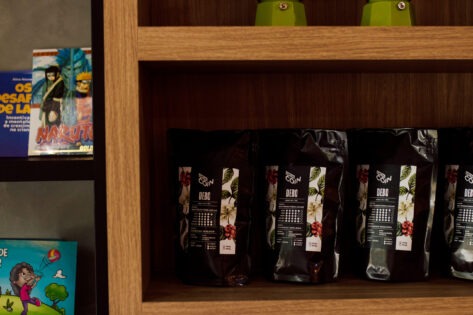
Here at Consciência Café, in Foz do Iguaçu, we offer various varieties of the beverage.
You can either enjoy it at the coffee shop itself, while enjoying the ambiance, reading a book, or taking advantage of the coworking space, or take it home to prepare and savor.
So what are you waiting for? Come visit us!
1st Edition: Tainá Chagas | Update: Joelma Oliveira